The short answer: an AI sales agent on WhatsApp can safely answer from facts the business has approved, quote prices from an approved list, ask the qualifying questions, write the answers into the CRM, send approved templates and hand the conversation to a person. A person should decide anything that moves money, changes a price, handles a complaint or falls outside the written rules. The agent should also say that it is an AI and offer a person.
The question isn't whether AI can hold a sales conversation on WhatsApp. It can. The question is which parts of that conversation a business is willing to have answered without a person checking first. Getting that line right is what makes an assistant safe to switch on.
Start with the rules, not the model
Before any automation, write down four things:
- 1.Approved facts: services, prices, opening hours, locations, policies. The assistant answers from these and nothing else.
- 2.Limits: what must never be said, such as an unconfirmed delivery date, a competitor comparison or a supplier's name you keep private.
- 3.Qualifying questions: what your best salesperson asks before a quote: dates, quantities, budget, location, the service needed.
- 4.Hand-over points: the moments a person takes over, every time.
The rules file is where the business's judgement lives. The model only applies it.
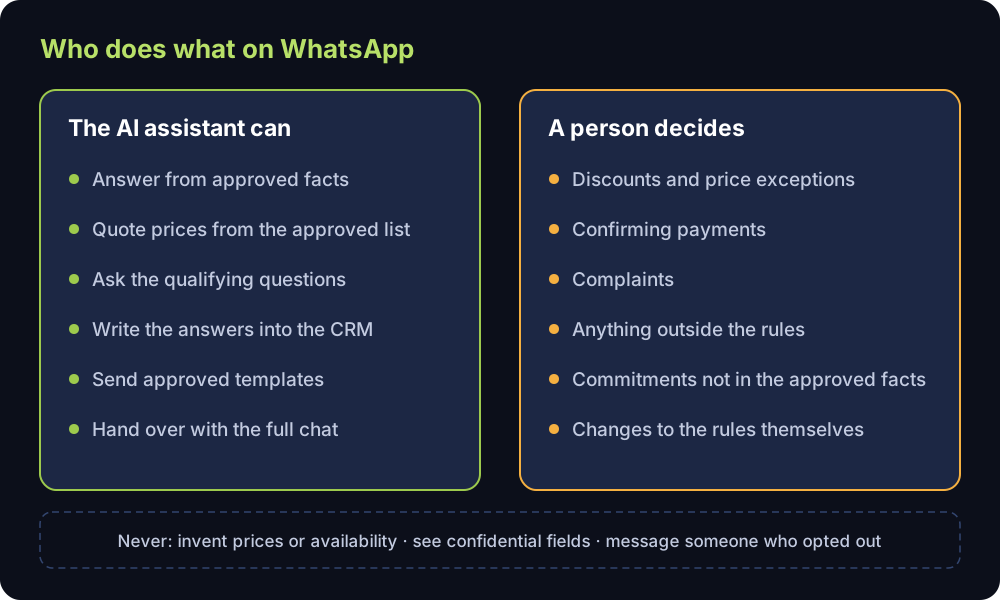
What the assistant can do
| Step | The assistant | A person |
|---|---|---|
| First reply | Answers at once, in the customer's language, from approved facts | Steps in when the question is outside the facts |
| Qualifying | Asks the questions and writes each answer into the lead | Reviews the qualified lead |
| Price | Quotes from the approved price list | Decides discounts and exceptions |
| Availability | Shares what an approved source says | Confirms anything the source doesn't cover |
| Payment | Sends the amount and payment details you approved | Checks the payment and confirms it |
| Complaint | Acknowledges it and hands over | Handles it |
| Follow-up after 24 hours | Sends an approved template | Decides on any message outside the templates |
Why these steps need a person
- Prices and availability are commitments. A made-up price or a promised slot becomes a promise the business has to honour or retract. Keep both to approved sources.
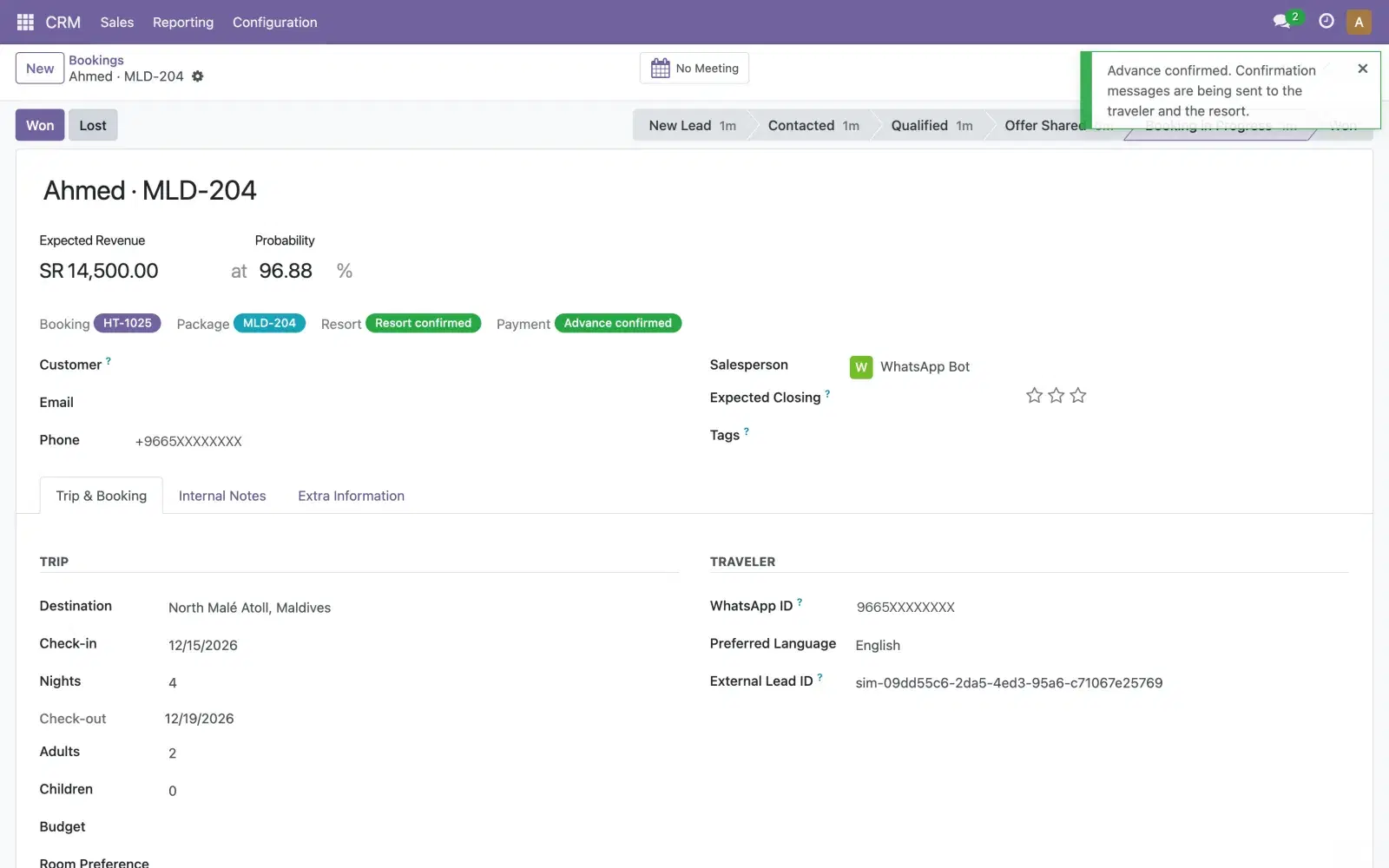
- Payments need a check. In our demo build, the one manual step is a person checking the bank and clicking Confirm Advance in Odoo; that click then sends the confirmations (see it on the service page).
- Complaints need authority. A person can apologise, compensate or escalate; an assistant should acknowledge and pass the conversation on with the full history.
- Some information should never reach the AI. If a detail must stay private until a step is done, don't give it to the model at all. In the demo, the resort's name stays out of the assistant's reach until the advance is paid, so it cannot reveal it.
The rules that apply
- WhatsApp's own terms. Meta's terms for the WhatsApp Business Platform bar AI providers from the platform "when such technologies are the primary (rather than incidental or ancillary) functionality being made available for use", and Meta decides who counts as an AI provider (Meta). A business using an assistant to serve its own customers is a different case from a general-purpose AI chatbot offered as the product itself. The same terms also limit how WhatsApp data may be used to train AI models, so check them with your provider.
- Saudi personal data law. Conversations with leads contain personal data, so the Personal Data Protection Law, overseen by SDAIA, applies (SDAIA).
- SDAIA's AI Ethics Principles. They include transparency and accountability, and call for human oversight of automated decisions that are hard to reverse (SDAIA). Payments, refunds and discounts are exactly that kind of decision.
- Consent. Meta requires a person's opt-in before a business messages them on WhatsApp (Meta).
Tell people they are talking to an AI
Our builds introduce the assistant as an AI and offer a person. It costs nothing, it sets the right expectations, and it makes the hand-over feel natural rather than like a failure.
Review what it said
Log every message on the lead in your CRM, and read a sample with your team each week at the start. Most improvements are rule changes: a missing fact, a question it should have asked, a hand-over that should come earlier.
Where Mantiqi fits
The AI Lead Desk is built on exactly this split: your rules file, enforced on every reply; qualifying answers written into Odoo CRM; and approvals in Odoo that send the next messages. For the full picture, read the guide to omnichannel lead management in Odoo CRM, and for the follow-up rules, the WhatsApp 24-hour window explained.