The short answer: omnichannel lead management means every enquiry, whether it comes from an ad form, an Instagram or Facebook message, WhatsApp, email or your website, becomes one lead in one CRM, tagged with where it came from, and gets a first answer without waiting for someone to be free. In Odoo CRM that takes three things: each channel connected to the CRM, one record per person, and clear rules for who replies (a person, a template or an AI assistant) and when a person takes over.
Leads reach a Saudi business through more channels than its CRM was set up for. This guide covers how to bring them into one Odoo CRM pipeline, what each channel's own rules allow, and where automation helps and where it should stop.
Why leads get lost between channels
Each channel has its own inbox and its own owner. Ad sign-ups sit with whoever downloads the lead forms, Instagram and Messenger messages sit in the Page inbox, WhatsApp chats live on whichever phone holds the number, email goes to a shared address, and website forms go wherever the developer pointed them. Three things follow:
- The reply depends on who happens to see the message first.
- The same customer appears twice: once from an ad, once on WhatsApp.
- Nobody can say which campaign brought the sale, because the source never reached the CRM.
Speed matters here. Harvard Business Review's study of online sales leads ended with a blunt line: "most companies are not responding nearly fast enough" (Harvard Business Review, March 2011).
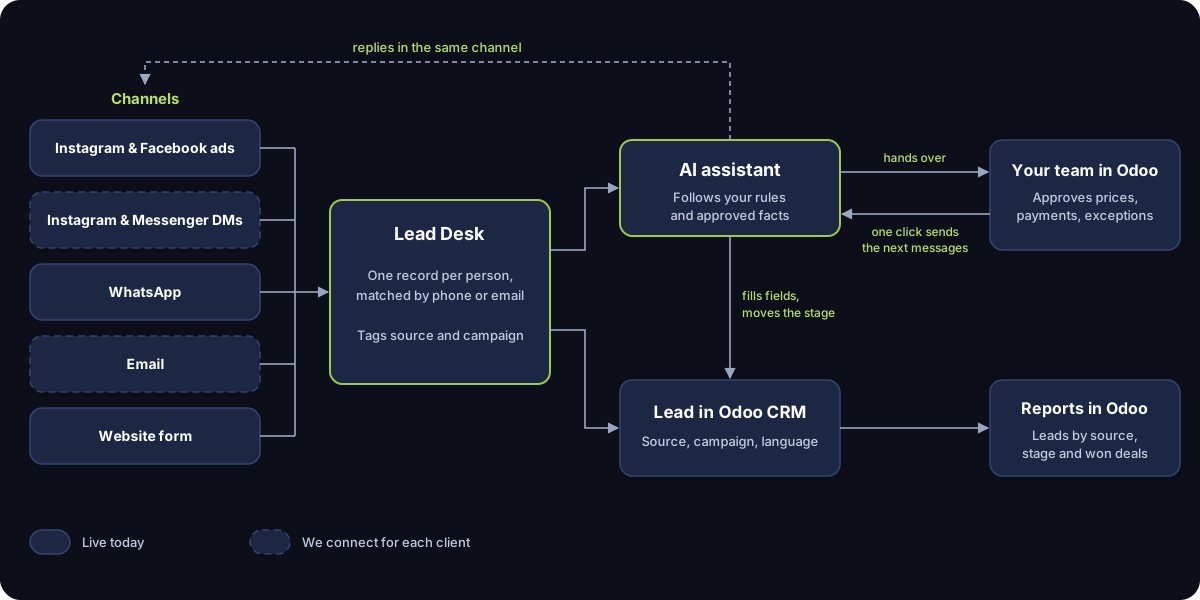
The five channels and what each one allows
| Channel | How a lead arrives | When you can reply | What you need |
|---|---|---|---|
| Instagram and Facebook lead ads | Meta sends a webhook for each new lead, and the form answers are fetched with the leads_retrieval permission (Meta) | On the channel the person agreed to; for WhatsApp, the form needs an opt-in | A Meta app with the lead ads permissions |
| Instagram and Messenger messages | Each message reaches your app through the Messenger Platform or the Instagram messaging API | Within the standard messaging window, 24 hours for most user actions; a person (not automation) can reply for 7 days with the Human Agent tag (Meta) | Messaging permissions approved in Meta's App Review, and a verified business (Meta) |
| The WhatsApp Business Platform sends each message to your webhook | Freely within 24 hours of the customer's last message or call; after that, only templates Meta has approved (Meta) | A WhatsApp Business Account, and the customer's opt-in before you message them (Meta) | |
| An email alias on the sales team turns each incoming email into a lead (Odoo) | No window | The alias, set on the sales team in Odoo | |
| Website form | The form posts straight to the CRM, or to a desk in front of it | No window | Form fields mapped to the lead, with the UTM tags of the visit |
Two rows need care. Lead ads are not a conversation: they hand you contact details, and the first message goes out on whichever channel the person agreed to (the lead ads guide covers that route step by step). And the Instagram and Messenger rows only work once Meta has approved your app, which takes its own review time.
One record per person
The same person writing from an ad and then on WhatsApp is one lead; two colleagues from the same company are two contacts. Match on phone number (in international format) and email before you create a new lead, and store where it came from. Odoo CRM records the UTM source, medium and campaign on leads, and its marketing attribution report groups leads by them (Odoo). If the source isn't captured when the lead is created, it can't be added back later.
Who replies first: a person, a template or an AI assistant
- A person suits high-value, low-volume enquiries, as long as someone is actually free when the message arrives.
- A template suits fixed messages: an acknowledgement, opening hours, a brochure. On WhatsApp, anything sent after the 24-hour window must be a template Meta has approved (Meta).
- An AI assistant that follows your rules answers from facts you approve (services, prices, hours, policies), asks your qualifying questions and writes each answer into the lead. Anything outside the rules goes to a person.
Whichever you choose, write the rules down first: what may be quoted, what must never be said, which questions qualify a lead, and which steps always need a person. Payments, discounts and complaints belong on that last list.
Hand-over without losing the thread
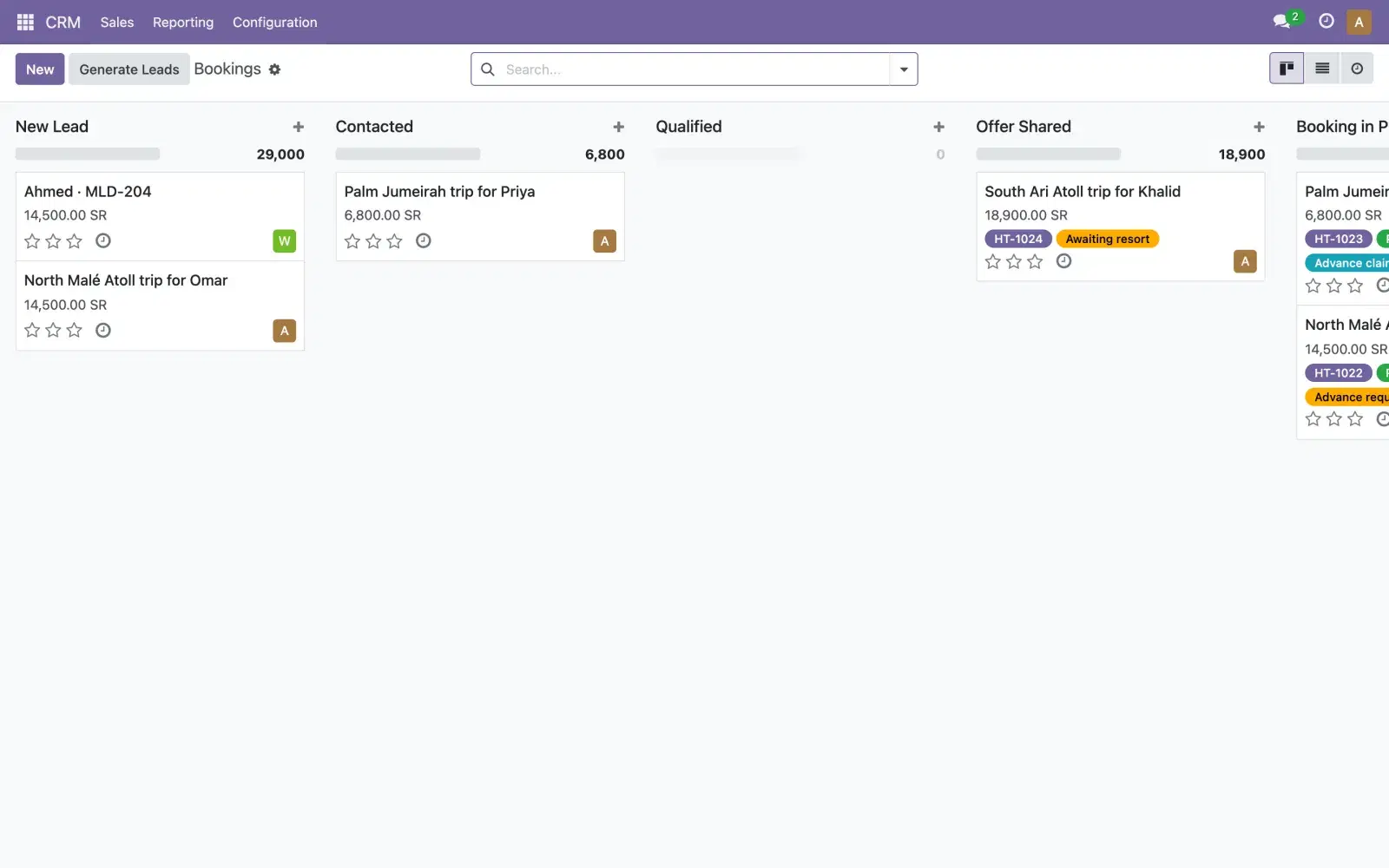
The hand-over is where most automations break. Keep the whole conversation on the lead in Odoo, let the person act from the lead itself (approve a price, confirm a payment), and let that action send the next message to the customer. Then nobody copies details between screens, and the customer never has to repeat themselves.
Reporting from Odoo
Once every lead carries its source, Odoo can show leads by source, medium and campaign, how they move through your stages, and which ones were won. That answers the question marketing actually asks: which ads brought deals, not just clicks (Odoo).
Personal data
Leads are personal data. Saudi Arabia's Personal Data Protection Law, overseen by SDAIA (SDAIA), and the UAE's Federal Decree-Law No. 45 of 2021 (UAE Government) both apply to them. Keep the record in your own CRM, give each tool only the fields it needs, and have your legal team approve the consent wording on your forms. This guide is not legal advice.
A checklist to start
- 1.List every place a lead arrives today, and who reads it.
- 2.Set the lead fields and stages in Odoo, with UTM source, medium and campaign.
- 3.Connect first the channels that already bring the most leads.
- 4.Write the reply rules: approved facts, limits, qualifying questions, hand-over points.
- 5.Add an opt-in line to every form that leads to a WhatsApp message.
- 6.Review the first weeks of conversations with your team, and adjust the rules.
Where Mantiqi fits
We build this as the AI Lead Desk, around each business's own steps. WhatsApp on Meta's official Cloud API, ad and website sign-ups, and Odoo CRM are live in our builds today; Instagram Direct, Messenger, Lead Ads synced straight from Meta, and AI replies to email are connected for each client. The service page shows one build end to end, a demo for a travel agency with invented data.